CAORC Logo

Opportunity: CAORC Overseas Faculty Development Seminars (Deadline: 12/2/24)

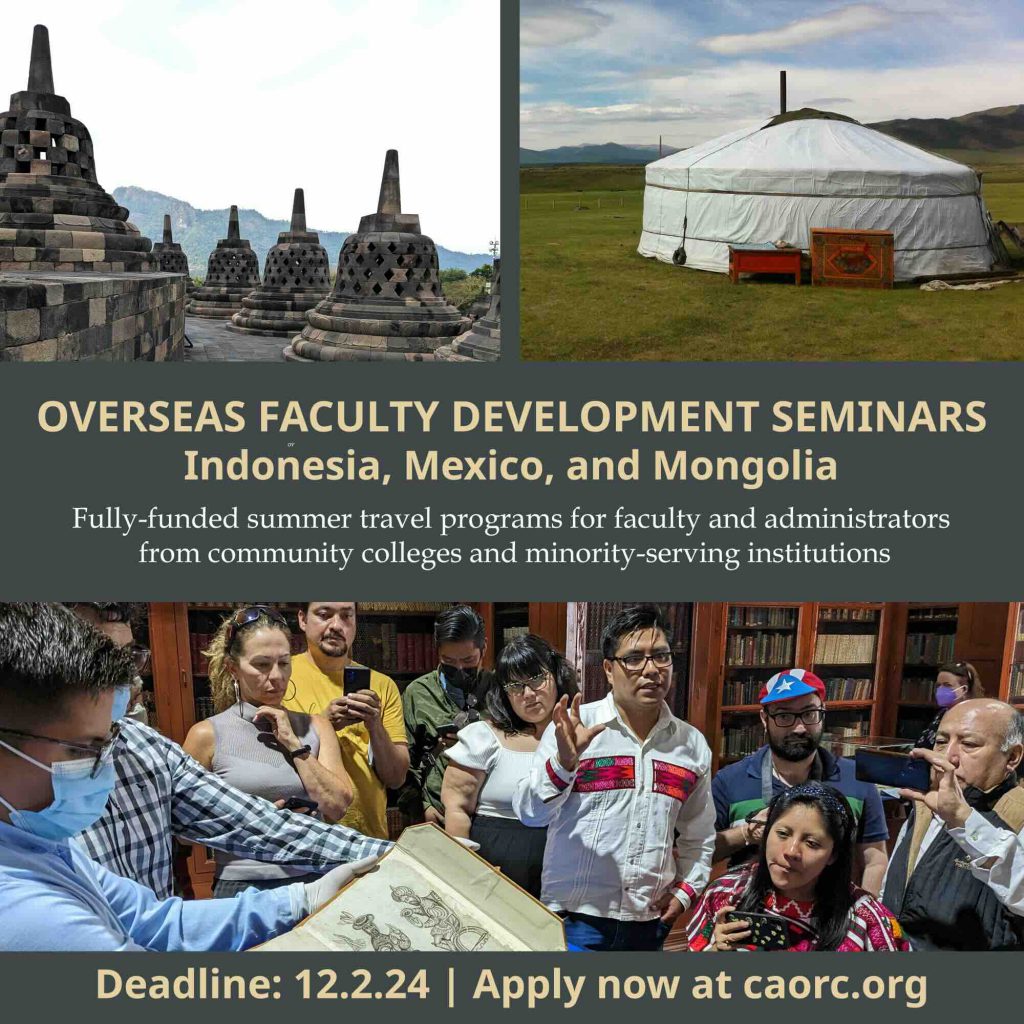
The CAORC Overseas Faculty Development Seminars are fully funded, short-term programs designed for faculty and administrators at U.S. community colleges and minority-serving institutions. The objective of these seminars is to provide participants with international experience to help them develop and enhance curricula at their home institutions. The award covers round-trip travel, accommodations, meals, and site visits. The Summer 2025 series features seminars presented by Overseas Research Centers in Indonesia, Mexico, and Mongolia. The deadline for applications is December 2, 2024.

Learn more and apply now at caorc.org.
OFDS
Conferencer Image

Thank you, Knoxville: Resources and Information from the National Conference

Thank you, Knoxville: Resources and Information from the National Conference

We want to thank everyone for another truly wonderful CCHA National Conference! We enjoyed your presentations and scholarship, and we loved the sights and sounds of Knoxville, which even included a Pride parade at our doorstep on Friday. Knoxville truly is a dynamic and diverse city! Please be sure to check out the link below for more on opportunities and information from our three amazing Friday plenary speakers and others. We’ll be in touch with more CCHA events and opportunities in the coming months, and we can’t wait to see everyone next year at Lane Community College in Eugene, Oregon!

American Council of Learned Societies (ACLS)
The following information provided by Nike Nivar and John Paul Christy:

Modern Language Association (MLA)
The following resources were mentioned by Paula Krebs:

American Philosophical Association (APA)
The following resources were mentioned by Amy Ferrer:

American Historical Association (AHA)
The following resources were mentioned by James Grossman:

National Endowment for the Humanities (NEH)
The following resources were shared by Julia Nguyen

The following information was shared by Aaron Fai:
The Consortium of Humanities Centers and Institutes (CHCI) is a global forum that strengthens the work of humanities centers and institutes through advocacy, grant-making, and inclusive collaboration. CHCI advances cross-institutional partnerships, recognizes regional humanities cultures, and mobilizes the collective capacity of the humanities to engage the most pressing issues in society today.
CHCI is committed to supporting community colleges and other access-oriented institutions around the world to gain visibility and recognition for your research and methodologies, and to connect your faculty and students to participate in global humanities research collaborations. Our consortium supports over 300 humanities organizations and affiliates around the world, and we welcome you to join us as a full member. Complimentary three-year memberships are available to access-oriented institutions and any organization operating at $50,000 USD and under. We simply ask that you participate in one of our programs or Networks during the course of your membership, and the complimentary membership will be renewable as long as you are a participating member.
1. Before joining, please consider:
  • Signing up for our newsletter, which will give you a sense of our activities, rhythms, and opportunities (Archive available)
  • Reading our recent Annual Report and summaries of quarterly board meetings (Governance)
  • Explore our membership directory for potential partner institutions in your region and worldwide
2. To join CHCI, please fill out this brief form, at the bottom of which describes our membership tiers and the complimentary membership in more detail.
3. Once you join, your membership benefits include:
  • Participating in our Initiatives, and apply for up to $15,000 in funding for theme-relevant program and projects
  • Applying for funding of up to $10,000 from our Membership Activity Fund for collaborations with other centers and institutes
  • Finding scholarly and administrative connections in our Networks, which include the Public Humanities and Environmental Humanities
  • Informing the wider membership of your events and opportunities
  • Participating in our Humanities Leaders Mentorship Program
  • Applying for a scholarship to attend our Annual Meeting
  • Hosting a CHCI-ACLS fellow
  • Requesting data reports and analysis on the CHCI membership from staff
For questions and inquiries about our programs or membership, don’t hesitate to contact Membership and Diversity Officer Aaron Fai, afai@berkeley.edu.
NHA Primary Icon Logo

NHA Webinar: Attracting Students to the Liberal Arts Through Integrative Curricula

We are pleased to announce a webinar launching our newest report, entitled Attracting Students to the Liberal Arts Through Integrative Curricula, on October 24th. The report includes 12 in-depth case studies and 20 brief profiles. The highlighted initiatives integrate the humanities, social sciences, and/or natural sciences with applied approaches and pre-professional training, helping to demonstrate the value of a broad-based education to skeptical students. The report was researched and produced thanks to a generous grant from the Arthur Vining Davis Foundations.

The webinar will take place from 2–3 pm ET. We will offer broad takeaways from this national study and hear from project leaders representing three of the featured initiatives.

Panelists include:

  • Miriam Horne, Professor and Assistant Dean for Adjunct Support in the Core Division, Champlain College
  • Tracy Leavelle, Director, Kingfisher Institute for the Liberal Arts and Professions, Creighton University
  • Gayle Rogers, Andrew W. Mellon Professor of English and Department Chair, University of Pittsburgh

The panel will be moderated by Scott Muir, NHA’s director of undergraduate initiatives.

Learn more about the webinar and register here.

ACLS Logo

ACLS Fellowship & Research Opportunity for CC Humanities Faculty

American Council of Learned Societies Launches Fellowship Opportunity and Research Initiative for Community College Faculty in the Humanities 

Pilot Initiative Will Support Virtual, Hybrid, and In-Person Residencies at Humanities Research Centers for Community College Faculty in 2025  
The American Council of Learned Societies (ACLS) is pleased to announce a fellowship opportunity designed to advance the research of community college faculty in the humanities and interpretive social sciences. The pilot initiative, which is made possible by the support of the Mellon Foundation, will also explore the diverse contributions of the community college sector to humanistic scholarship.

The ACLS Community College Faculty Research Fellowships offer scholars in the humanities and interpretive social sciences who teach at two-year degree-granting institutions the opportunity to pursue their research in virtual, hybrid, or on-site residencies at select humanities research centers. In 2025, ACLS will offer up to 13 awards for community college faculty to take up two- to three-month fellowships at one of three participating organizations:

“Community college faculty are pursuing exciting, innovative research in the humanities, and the academy has much to gain from their perspectives as scholars and teachers deeply engaged with their local communities,” said John Paul Christy, Senior Director of US Programs at ACLS. “ACLS is grateful to our partners at the American Antiquarian Association, the Folger, and the Newberry for their partnership in this initiative, and for their commitment to enhancing access to the networks and resources their centers offer for community college faculty across the country.”

Based on feedback from faculty in the community college sector, the awards are designed to be flexible and allow fellows to design a residency that works best for them, from fully on-site to fully remote. The awards offer $3,500 per month in support, plus an additional $1,500 per month to defray costs associated with travel and accommodation at their selected research center.

In addition to offering direct support for research, the program will bring fellows and other scholars together with funders and the leadership of research centers and scholarly associations to advise on the development of more inclusive infrastructure for scholars in teaching-intensive faculty roles.

ACLS is now accepting applications for the ACLS Community College Research Fellowships, with all proposals due by December 4, 2024, 9:00 PM EST. Applicants are invited to consult the ACLS program page for more information and to sign up for an informational webinar, which will be recorded, and for office hours sessions where they can receive answers to their questions from ACLS program staff.

This fellowship opportunity and learning project is part of the ACLS Community College Humanities Initiative, a suite of research, funding, and convening activities designed to advance the humanities in the community college sector.

Learn More About Application and Eligibility Requirements
Formed a century ago, the American Council of Learned Societies (ACLS) is a nonprofit federation of 81 scholarly organizations. As the leading representative of American scholarship in the humanities and interpretive social sciences, ACLS upholds the core principle that knowledge is a public good. In supporting its member organizations, ACLS expands the forms, content, and flow of scholarly knowledge, reflecting our commitment to diversity of identity and experience. ACLS collaborates with institutions, associations, and individuals to strengthen the evolving infrastructure for scholarship. In all aspects of our work, ACLS is committed to principles and practices in support of racial and social justice.

The Mellon Foundation is the nation’s largest supporter of the arts and humanities. Mellon believes that the arts and humanities are where we express our complex humanity, and that everyone deserves the beauty, transcendence, and freedom to be found there. Through its grants, Mellon seeks to build just communities enriched by meaning and empowered by critical thinking, where ideas and imagination can thrive. The Foundation makes grants in four core program areas: Arts and Culture; Higher Learning; Humanities in Place; and Public Knowledge.

CAORC Logo

Opportunity: CAORC-NEH Research Fellowship (Deadline 1/15)

CAORC-NEH RESEARCH FELLOWSHIP

The
CAORC – National Endowment for the Humanities Research Fellowship is accepting applications! This fellowship provides the opportunity for scholars to carry out advanced research in the humanities and to spend significant time in one country with an Overseas Research Center as a base. Approximately three to four awards will be granted and fellowship stipends are $5,000 per month for four to six consecutive months.

Fields of study include, but are not limited to, anthropology, history, philosophy, archaeology, linguistics, religious studies, languages, literature, literary criticism, ethnomusicology, and art history. In addition, research that embraces a humanistic approach and methods will be considered.
 

Applicants must hold a PhD or a terminal degree, or have completed all requirements, except for the actual conferral of the degree, by the application deadline. Applicants must be US citizens or foreign national scholars who have been resident in the US for at least three years. Please see the fellowship guidelines for more information.


Minority scholars and scholars from Minority-Serving Institutions are encouraged to apply.


Deadline: January 15, 2025
Apply here.
Fellowship Guidelines: here.
Monroe Logo

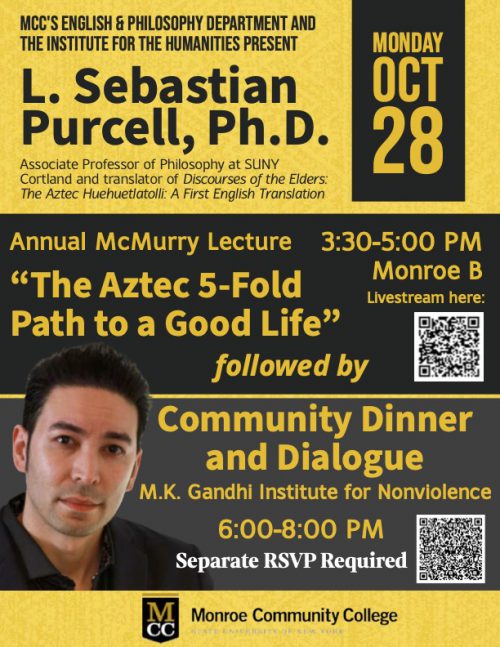
Annual McMurry Lecture: 10/28 from Monroe CC English & Philosophy Dept.

The Monroe Community College English & Philosophy Department is pleased to announce the annual McMurry Lecture by. Lynn Sebastian Purcell, Associate Professor of Philosophy at SUNY Cortland.

Save the Date: Oct. 28, 3:30 to 5:00, Monroe B

LivestreamMcMurry Lecture 2024

Professor Purcell’s topic is The Aztec’s 5-Fold Path to A Good Life

The Aztecs had a robust philosophical tradition that, unlike what popular culture suggests, was centered on learning to live a cooperative life well. This path had five parts. First, you must recognize that each of us slips up and errs. Second, we do this because we are unbalanced. Third, the solution to this lack of balance is to grow deep roots in our communities and with our dearest friends. Fourth, this is done through exercising the virtues of prudence, humility, justice, moderation, and courage. Finally, you must engage in a series of drills–sometimes called spiritual exercises–to form the right habits of those virtues. Their view is both strikingly like Aristotle’s yet at each moment differently focused.

Livestreamed at McMurry Lecture 2024

For more information, contact Robert L. Muhlnickel at rmuhlnickel@monroecc.edu.

McMurry Lecture Flyer full ADA compliant
The Great Questions Foundation in red, stylized text on a white background.

The Great Questions Foundation Faculty Fellowship Program

Application Deadline: October 15th, 2024

Community college faculty members are invited to assemble a team at their institution and apply to collaborate in this national project to expand discussion-based liberal education opportunities for community college students. Join your colleagues in this movement to make general education liberal education at community colleges.

Funded by a generous grant from the Mellon Foundation, The Great Questions Faculty Fellowship program will place 20 community college faculty members who teach general education courses in a two-year faculty leadership incubator, positioning them at the creative center of discussion-based and student-centered pedagogy in the liberal arts. Fellows will work to redesign a frequently taught course to center the discussion-based study of transformative works and ideas while exploring and practicing discussion-based pedagogies, and active, collaborative, and reflective assignment design with faculty leaders. Each Fellow will develop their capacity as institutional leaders and will organize at least one humanities-centered event at their institution with TGQF’s support. Additionally, Fellows will have the opportunity to apply for grants from TGQF of $5,000 – $40,000 to support the further development of humanistic inquiry in the liberal arts at their institutions.

Along with regular online workshops, engaging with invited community college faculty leaders in liberal education work, Fellows will convene in two in-person meetings during their fellowship tenure, one held in Austin, Texas, and another at a Fellow’s home institution, to-be-determined. All travel costs for these meetings, including hotel, flights, and group meals will be covered by TGQF.Each fellow will receive a $5,000 stipend for their full participation in the fellowship program.

Prospective Fellows who teach in the humanities and humanistic social sciences at community colleges are encouraged to apply as campus teams of 3-4 faculty. The application deadline is October 15th, 2024.

Find out more and apply here: https://www.tgqf.org/fellowship/. If you have any questions about this opportunity, please let me know. I’d be grateful if you would please share this opportunity widely within your networks of community college faculty colleagues.

Thanks!

teds signature

Ted Hadzi-Antich Jr.

Executive Director

The Great Questions Foundation (501c3)

NewMLALogo

MLA Prof. Dev. Series: Humanities Leadership for Community College Faculty

Humanities Leadership for Community College Faculty

A Professional Development Series Offered in Collaboration by MLA and CCHA

If you are an aspiring leader in the humanities at a community college—a department chair, assistant dean, or engaged faculty member—this professional development opportunity is for you!

The humanities play a critical role in the mission of two-year institutions. This virtual workshop series offered jointly by the Modern Language Association and the Community College Humanities Association will provide current and aspiring community college leaders with the tools to argue for the centrality of the humanities to that mission, advocate for the humanities on their campuses and in their communities, and design strategies in the areas most relevant to community college faculty members and students.

Humanities Leadership for Community College Faculty affords an opportunity to grow your network and to earn a leadership credential through our partnership with Credly. Seats are limited, so register soon! Special rates are offered to members of both MLA and CCHA.

Find out more information about this opportunity HERE.

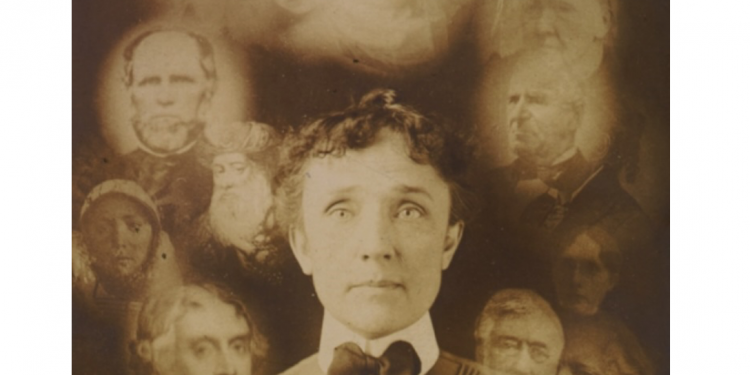
Bordered Spirit Image

Doppelgängers & Ghosts: Spiritualism and Spirit Photography


You can view the recording from this event here.

Please join us on Thursday, August 8th, at 7:00 PM EST for the speaker event: Doppelgängers & Ghosts: Spiritualism and Spirit Photography. Please also see the linked flyer below for more information.

Photography was invented and popularized during a period of enormous upheaval in political, social, technological and spiritual life- much like today. Also like today, the desire to give meaning to these enormous changes can find an outlet in new quasi-religious modes of understanding that may not stand up well to the icy blade of reason. The desires of a mass of less-than-ideally-informed believers to uncover “the real truth” can make them vulnerable to grift, hucksterism, and hoaxes.

This virtual lecture examines the rise of Spiritualism as a religious force in the 19th century, in response to the perceived failure of rationalism to account for the nebulous woo-woo of life. Photography was soon put to service to “prove” the legitimacy of Spiritualist beliefs. The tension between reality and “what’s really going on” has not abated since.

Speaker Bio:

Scott Hilton is a Distinguished Senior Lecturer at the University of Arlington, Texas in photography. He teaches Introduction to Photography, Dark Room, Staged Environments, History of Photography, Alternative Processes, and Studio Photography. He is also the Chair of the Board of Directors for the Society of Photographic Education. He received his BA in Art at the University of California, Reno and his MFA in Art at California State University, Fullerton.

Event Flyer: CCHA Doppelgangers and Ghosts Flyer

NCPH Logo

Call for Proposals: The 2025 National Council on Public History Annual Meeting

NATIONAL COUNCIL ON PUBLIC HISTORY ANNUAL MEETING
MONTRÉAL, QUÉBEC, CANADA | MARCH 26-29, 2025

Solidarity (from the French solidarité) is a word for shared responsibilities and mutual obligations. It conveys a sense of interconnectedness with our world and interdependence upon each other. Long present in France’s code civile, to be in solidarity is to assume shared debts and claim shared successes, so that when we rise, we rise together.

As 21st century public historians, we work through multiple lenses, share diverse stories, and interpret and make relatable to the public complex histories that sometimes counter long-held ‘truths.’ As a result, our work beckons for a sense of collective purpose to support achieving common ground across the field.


The 2025 NCPH Annual Meeting will center around the theme Solidarity. Pondering the question—What does Solidarity mean in the field of public history?—leads us to consider what we collectively value in the field and how we progress together as public history workers. Amplifying voices, building connections, unifying our audiences, advocating for and revealing authentic histories, fostering and promoting safe spaces, and mirroring these values internally within our organizations are a few examples of how we realize Solidarity across the field.

While submissions on all topics are welcome, in exploring Solidarity, the Joint 2025 Program and Local Arrangements Committee co-chairs particularly encourage you to consider a few of the examples below:

  • Sessions related to public history labor and public historians as workers, including efforts to improve compensation and working conditions in the field and in our institutions;
  • Sessions which model collaboration between public historians and relevant stakeholders, especially community members and grassroots organizers;
  • Sessions which demonstrate solidarity between public historians and activist movements or protests;
  • Sessions which display international cooperation and collaboration across borders;
  • Sessions which explicitly consider our shared responsibilities as public historians: to each other, to the communities we serve, to the pasts, people, and places we interpret, and to the world we live in;
  • Sessions which ask us to evaluate the past and present work of public history to consider the shared debts we must pay;
  • Sessions which consider public history work as a projet de société—in Québec, a societal project.


PRESENTATION FORMATS MAY INCLUDE:

ROUNDTABLE (90 mins): Roundtables are typically about half presentation and half discussion among presenters and the audience. Presenters should bring targeted questions to pose to others at the table in order to learn from and with each other.

STRUCTURED CONVERSATION (90 mins): These facilitated, participant-driven discussions are designed to prioritize audience dialogue and may contain little or no formal presentation component.

TRADITIONAL PANEL (90 mins): At least three presenters, a chair, and optional commentator. While this is the most traditional format, we still highly discourage the reading of papers.

COMMUNITY VIEWPOINTS (90 mins): A showcase that features a variety of stakeholder and collaborator perspectives across stages of the project’s development, with a particular focus on community participants and grassroots collaborators.

INDIVIDUAL (~30 mins): While individual proposals are welcome, individual presentations will either be shorter than a full session or will be combined with similar proposals to make a full session. These should be presentations of your work and, like all other sessions, not a reading of a paper.

WORKING GROUP (2 hrs): Facilitators and up to 12 discussants grapple with a shared concern. Before and during the meeting, working groups articulate a purpose they are working toward or a problem they are actively trying to solve and aim to create an end product. Proposals are submitted by facilitators, who will seek discussants after acceptance.

WORKSHOP (4 or 8 hrs): A half- or full-day workshop is a more intensive and skills-based deep-dive into a topic that includes concrete practical tools and lessons for a smaller group of attendees (recommended 15- 30 people).

PROPOSAL SUBMISSION GUIDELINES

OPTIONAL EARLY TOPIC PROPOSALS: Consider submitting an optional early topic proposal by June 15, 2024 to gather suggestions on your topic, seek collaborators or co-presenters, and get feedback from the 2025 Program Committee and members of the NCPH community. Respondents will contact the original submitter directly with their ideas or offers, and the submitter may choose to select additional participants, refine the proposal, and complete a full proposal form online by the July deadline.

FINAL PROPOSALS: Submit your fully formed session, working group, or workshop proposal online by July 15, 2024 via https://ncph.org/conference/2025-annual-meeting/cfps/. (Please note that working group and workshop proposal forms are separate from the main session proposal form.)

When filling out your proposal, please let us know if your session will be in English or in French, as we are planning for a track of sessions in French with simultaneous translation.

While individuals are not prohibited from presenting in consecutive years at the meeting, session proposals that include new voices will receive preference. Additionally, participants may be presenting members of only one session, but may also be discussants in Working Groups or serve as chair/facilitator on a second session.

QUESTIONS? Please email Program Manager Meghan Hillman at meghillm@iu.edu. The Call for Posters and Call for Working Group Discussants will come in spring 2024.